Why a Jeep Gets You to the Light
Most Zion photos are taken from the same handful of pullouts on the canyon floor, at the same hours, with the same crowds in the frame. A jeep tour takes you to the mesas around the park, where the angle is different and the tripod has room.
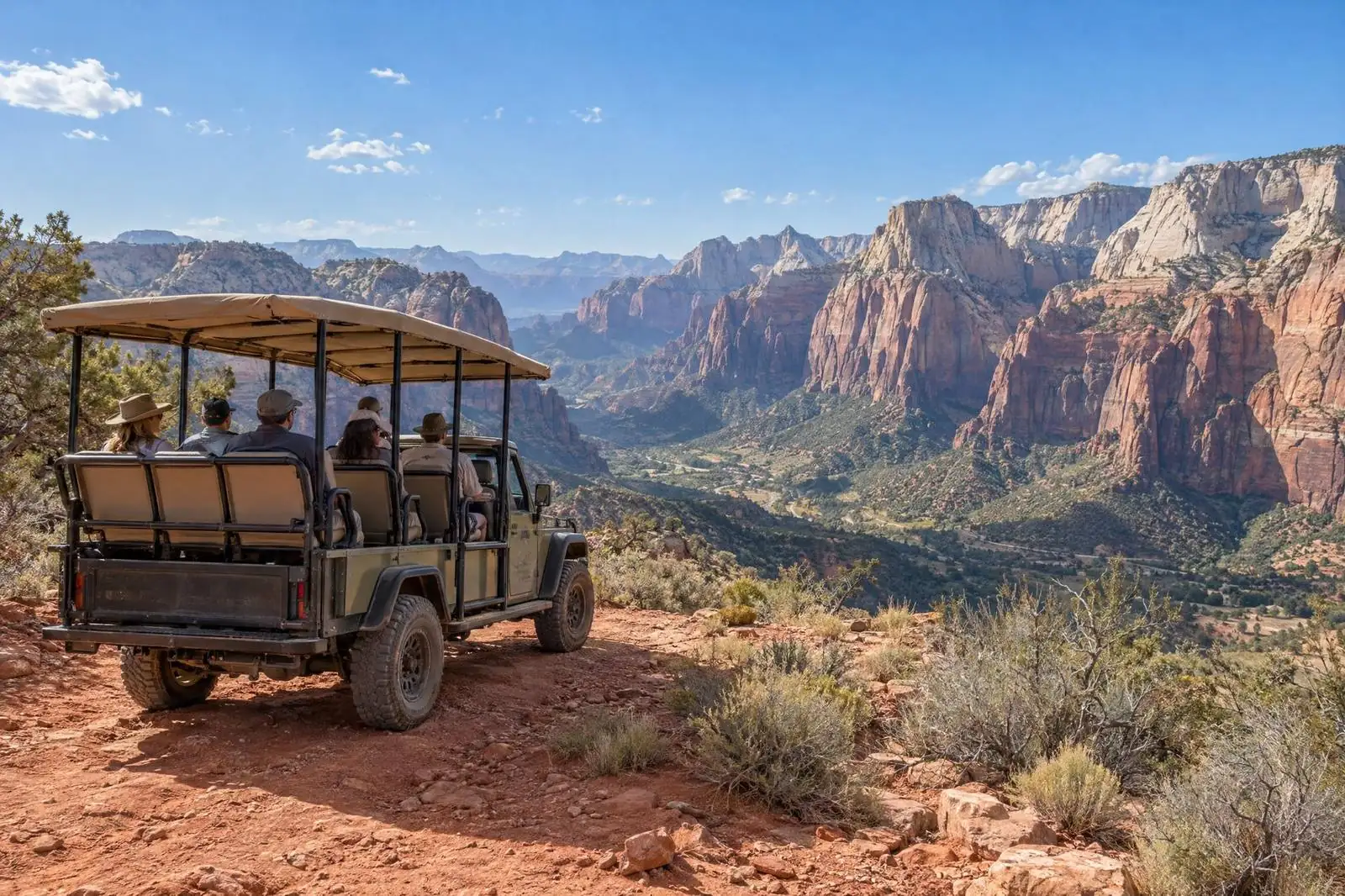
From the Mesa Vista side you look east at the 3,000-foot cliffs of Zion, a wall of sandstone that fills a long lens and still leaves sky above it. From the Outback you get open desert, rock art and a ghost town that became a film set. Neither view is available from the shuttle.
The Jeeps stay outside the park boundary. That is not a limitation for photographers; it is the reason the light and the foreground are different from every postcard you have seen. Bring a wide lens as well; the desert foreground is half the picture.
Golden Hour on the Mesa
The hour before sunset and the hour after sunrise do more for sandstone than any filter. Low light rakes across the rock, pulls out texture and turns the cliffs a deeper red than they look at noon.
In the evening, the cliffs of Zion catch the last direct light while the mesa below falls into shadow. That contrast is the shot: warm rock above, cool desert below. In the morning the order reverses, and the mesa wakes up before the canyon does.
A private tour lets you build the schedule around that light instead of hoping the shuttle timing works out. Tell us you are shooting golden hour and we will plan the route and the stops around it.
Photo Stops on Request
Our drivers stop for photos, and they stop more often when you ask. If you see a composition forming, say so; the road is slow enough that a stop costs a few minutes, not the afternoon.
Drivers also take group photos, which solves the problem of the person who is always behind the camera. Hand over the phone, get everyone in front of the mesa, and return the favor at the next stop.
Bring a shot list if you have one. A guide who knows you want a silhouette at sunset, a close-up of rock art and a wide desert frame will find places that do all three without backtracking.
Gear That Earns Its Seat
You do not need a full kit, but a few items pay for themselves in this light. A polarizing filter cuts glare on sandstone and deepens a blue sky. A zoom in the 70–200mm range compresses the cliffs and isolates detail. A wide lens handles the mesa foreground.
Pack a microfiber cloth, a spare battery and a strap you trust. Dust is constant on dirt roads, and a lens cap that lives in your pocket will be lost by the second stop. A small tripod fits in the vehicle if you tell us when you book.
Leave the heavy kit at home if you are traveling with kids. One good lens and a phone will cover more than you think.
Shooting From a Moving Jeep
The Jeep moves, and the road is rough. Set a fast shutter, at least 1/500 of a second in daylight, and brace the camera against the door frame rather than your knee. Take bursts; one frame in five will be sharp.
Keep the lens clean and shoot through an open window when you can. Glass adds haze and reflections, and dust on the windshield shows up in every frame. If you are in an enclosed Jeep, ask the driver to stop for the shots that matter.
Do not stand up or unbuckle to get a better angle. The best photo of the trip is not worth a fall on a dirt road. If you want a specific shot, ask the driver to pull over rather than shooting through motion.
After Dark
Zion is an International Dark Sky Park, and the mesas west of Virgin are dark enough for long exposures. Our night sky tour climbs above 5,000 feet, sets out recliner chairs, and brings a telescope and binoculars for the hours after sunset.
For night photography, a tripod and a wide, fast lens help, but a phone on night mode can hold its own if you brace it. Expose for 10 to 20 seconds, keep the flash off, and dim your screen so you do not ruin everyone else's night vision.
Clouds are out of anyone's control. Check the moon phase, bring a layer, and treat whatever sky shows up as the assignment.
Frequently asked questions
Can I bring a tripod on a jeep tour?
A small tripod fits in the vehicle; mention it when you book so the guide can plan space. For night photography, a compact travel tripod is the easiest option.
Do the tours stop for photos?
Yes. Drivers add photo stops on request and take group photos, so you can get the shot you want without missing the rest of the ride.
What lens should I bring for Zion?
A standard zoom covers most of it, and a 70–200mm helps compress the cliffs. Add a polarizer for glare and a cloth for dust; that combination handles most days on the mesa.